
 3 weeks ago
22
3 weeks ago
22
There is a specific kind of joy in unfolding a map of the British Isles and spotting a name that makes you double-take.
We are a nation built on a chaotic lasagna of ancient languages—Old English, Old Norse, Celtic, and Norman French—that have mashed together over millennia to produce place names that are historic, descriptive, and, to the modern ear, utterly filthy.
We have already covered the serious history of how England’s towns got their names in a previous article. But sometimes, you just need to pack the car, suppress a giggle, and hit the road to see the funny ones for yourself.
Here is the twist: these names aren’t just jokes. They are linguistic fossils. They tell us exactly what the landscape looked like a thousand years ago, long before the meanings of words shifted into the gutter.
So, buckle up. We are going on a road trip from the south coast to the Scottish Isles, exploring the history, the hilarity, and the surprisingly innocent origins of Britain’s rudest places.
Table of contents:
- Stop 1: Shitterton, Dorset
- Stop 2: Scratchy Bottom, Dorset
- Stop 3: Sandy Balls, Hampshire
- Stop 4: Crapstone, Devon
- Stop 5: Three Cocks, Wales
- Stop 6: Bell End, West Midlands
- Stop 7: Nob End, Greater Manchester
- Stop 8: Bitchfield, Lincolnshire
- Stop 9: Wetwang, East Yorkshire
- Stop 10: Cockermouth, Cumbria
- Stop 11: Brokenwind, Aberdeenshire
- Stop 12: Twatt, Orkney (and Shetland)
- The Verdict?
Stop 1: Shitterton, Dorset
The Location: A picturesque hamlet of thatched cottages near Bere Regis.
The Meaning: It is exactly what you think it is.
We start in Dorset with perhaps the most famous rude name of them all. Shitterton looks idyllic—a chocolate-box collection of 18th-century buildings nestled near the river.
But its name, recorded in the Domesday Book of 1086 as Scatera, is derived from the Old English word for a sewer or midden.
Historically, the stream that cuts through the village was used as a public latrine. Therefore, Shitterton literally translates to “The Farmstead on the Sewer Stream.”
The Great Sign Heist For decades, Shitterton had a problem. Its standard metal road sign was stolen so frequently by souvenir hunters that the council simply stopped replacing it.
In 2010, the residents, fed up with being invisible, chipped in to buy a 1.5-tonne block of Purbeck stone. They had the name engraved deep into the rock and concreted it into the ground. It hasn’t been stolen since.
Stop 2: Scratchy Bottom, Dorset
The Location: A clifftop valley near Durdle Door.
The Meaning: A rough valley.
Just a short drive from Shitterton lies the magnificent Scratchy Bottom. While it sounds like a personal itch, “Bottom” is simply an old Sussex and Dorset term for a valley or hollow.
“Scratchy” likely refers to the rough gorse and brambles found there. It famously featured in the opening scene of the 1967 film Far From the Madding Crowd. It sounds uncomfortable; it’s actually stunning.
Stop 3: Sandy Balls, Hampshire
The Location: A holiday village in the New Forest.
The Meaning: Geological, not anatomical.
Heading east into the ancient woodlands of the New Forest, we arrive at Sandy Balls. Far from being a crude joke, the name dates back to the reign of Henry VII.
 Sandy Balls: Named after gravel outcrops, not anatomy.
It appeared on maps as Sandyballas, which is a perfect description of the landscape: dome-shaped outcrops of sand and gravel found on the estate’s western boundary.
It is a beautiful spot for a walk, surrounded by winding rivers and ancient oaks. It serves as a reminder that language evolves; what was once a perfectly normal geological term now makes every camper giggle when they book their pitch.
Stop 4: Crapstone, Devon
The Location: A village on the edge of Dartmoor.
The Meaning: A family legacy.
Crossing into Devon, we find Crapstone. This village gained national fame when it was used in a TV advert for the RAC, prompting locals to protest that it was a real place with a proud history, not just a punchline.
 Crapstone sits on the edge of the stunning Dartmoor National Park.
The name likely derives from the local Crap family (a variant of ‘Crop’), who were significant landowners in the area.
It sits near Buckland Monachorum and serves as a gateway to the rugged beauty of Devon. It’s a great reminder to check the history before you judge—what was once just a surname is now a selfie spot.
Stop 5: Three Cocks, Wales
The Location: A village near Brecon, Powys.
The Meaning: A coat of arms.
Crossing the border into Wales, we stop at Three Cocks. While it draws plenty of sniggers from passing drivers, the name is actually a heraldic reference.
It is named after the Three Cocks Inn, a historic coaching inn that dates back to the 15th century.
The inn took its name from the coat of arms of the local Williams family of Gwernyfed, which featured three cockerels (roosters). So, rather than being rude, it’s a nod to the medieval aristocracy.
If you want to learn more about pub names then take a look at our Why is it Called That? Decoding the Secret Language of British Pub Signs
Stop 6: Bell End, West Midlands
The Location: A street in Rowley Regis.
The Meaning: Industrial heritage.
Heading north to the Black Country, we hit a name that sparked a civil war. Bell End is a historic row of houses near Stourbridge.
 Residents fought a fierce petition to keep the historic name of Bell End.
The name is widely believed to come from a local coal mine, the Bell End Colliery, or possibly a bell tower that stood nearby.
In 2018, a group of residents launched a petition to change the name, claiming they were being bullied and house prices were suffering.
However, a counter-petition titled “Leave the Historic Name of Bell End Alone” gained thousands of signatures, arguing that the name was part of the local heritage. The traditionalists won; the sign stays.
Stop 7: Nob End, Greater Manchester
The Location: A nature reserve near Bolton.
The Meaning: The end of a projection.
Just south of Bolton lies Nob End, which is, surprisingly, a Site of Special Scientific Interest (SSSI). The “Nob” here refers to a rounded projection of land or a small hill.
It is actually a fascinating place—a post-industrial landscape where toxic alkaline waste from 19th-century bleach works was dumped.
Over time, this created a unique “alkaline fen” habitat that now supports rare orchids and wildflowers found nowhere else in the region. It is perhaps the only place in Britain where you can admire rare flora while standing on a “Nob End.”
Stop 8: Bitchfield, Lincolnshire
The Location: A village near Grantham.
The Meaning: Bill’s Field.
As we head east, we pass the village of Bitchfield. While it sounds like a complaint, the name appears in the Domesday Book of 1086 as Billesfelt. Etymologically, it simply means “Bill’s Field” or “Open Land belonging to Bill.”
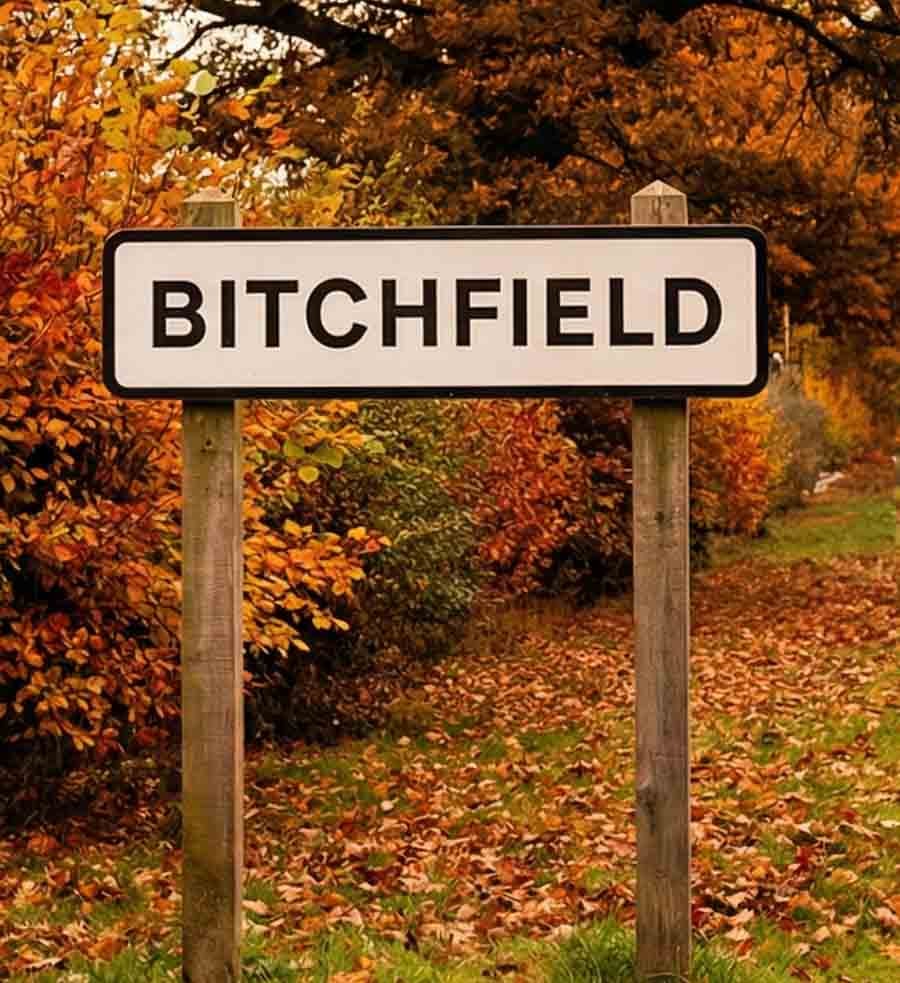
It consists of two groups of cottages known as Lower Bitchfield and Higher Bitchfield, which only adds to the comedy for visitors.
Stop 9: Wetwang, East Yorkshire
The Location: A village in the Yorkshire Wolds.
The Meaning: A place of justice.
Wetwang is a name that sounds inherently silly, but its origins are Viking and deadly serious. It comes from the Old Norse Vaett-vangr, meaning “Field of Summons” or “Field for the Trial of a Legal Action.”
 Wetwang: Originally a Viking “Field of Justice”.
This was likely a place where Viking justice was dispensed—a parliament field where disputes were settled, possibly by trial by combat.
It is a far cry from the modern playground interpretation. The village is incredibly proud of its name; the late Richard Whiteley (of Countdown fame) was once the honorary “Mayor of Wetwang,” a title he held with glee.
If you visit, grab some fish and chips at the local chippy—it’s a rite of passage.
Stop 10: Cockermouth, Cumbria
The Location: A Gem Town on the edge of the Lake District.
The Meaning: A crooked river mouth.
It is one of the most beautiful towns in Cumbria, the birthplace of William Wordsworth, and the gateway to the western lakes. The name is purely geographical: it is the mouth of the River Cocker.

The river name comes from the Brythonic Celtic word kukrā, meaning “The Crooked One,” describing its winding path.
There is nothing rude about it, until you say it out loud. While here, you can visit the Jennings Brewery or walk the banks of the river that gave the town its memorable handle.
Stop 11: Brokenwind, Aberdeenshire
The Location: A hamlet near Newmachar.
The Meaning: A winding path.
Crossing the border into Scotland, we find Brokenwind. While it sounds like the aftermath of a heavy meal, the name is likely a corruption of “Broken Wynd.”
In Scots, a wynd is a narrow, winding path or lane. It suggests a path that was perhaps uneven or interrupted. It was voted the third worst place name in the UK in 2012, but the locals seem to take it in their stride.
Stop 12: Twatt, Orkney (and Shetland)
The Location: A tiny settlement on the Orkney mainland.
The Meaning: A parcel of land.
We end our journey in the far north. Twatt is a name that tourists flock to for a photo.
 A linguistic fossil: Twatt comes from the Old Norse for “meadow” or “clearing”.
Like many names in the Northern Isles, it is pure Old Norse. It comes from þveit (thwaite), meaning a “small parcel of land” or a “clearing in a wood.”
It is the same linguistic root as the “thwaite” ending found across Yorkshire (like Braithwaite or Slaithwaite).
It just happens that in Orkney, the spelling took a turn that makes modern visitors blush. The sign here is famously difficult to photograph because, like Shitterton’s old sign, it has a habit of disappearing into the boots of tourists’ cars.
The Verdict?
From the sewer-streams of Dorset to the justice fields of Yorkshire, these names are not embarrassments to be changed; they are linguistic time capsules.
They remind us that our landscape was named by farmers, Vikings, and Saxons who called a spade a spade—or a sewer a shitter.
So next time you pass a sign for Pratt’s Bottom (Kent) or Great Snoring (Norfolk), don’t just laugh. Tip your hat to the history.











 English (US) ·