
 2 weeks ago
8
2 weeks ago
8
There is a moment in late February when the British winter finally breaks. It isn’t marked by a change in temperature or the blooming of a flower. It is marked by a sound.
Standing in the garden as the light fades, you hear it: a rich, fluty, melodious warble drifting down from a chimney pot or the highest branch of a sycamore.
It is a sound of lazy confidence, a wandering tune that feels less like a territorial claim and more like a jazz improvisation. It is the Blackbird (Turdus merula).
To many, he is just “the black bird.” He is the background noise of suburbia, the shadow hopping across the lawn.
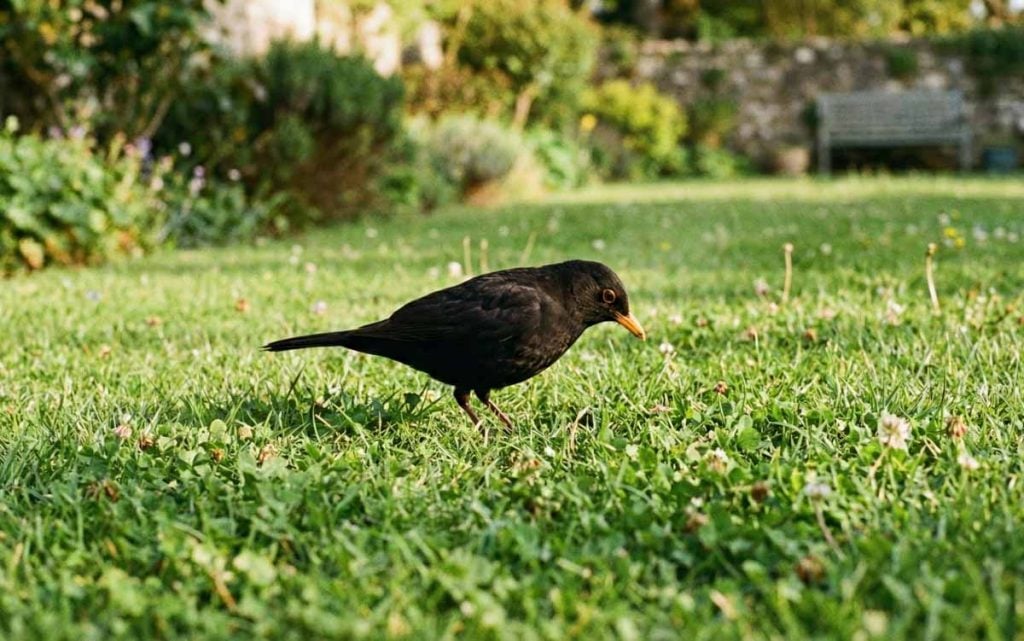
But to dismiss the Blackbird as common is to miss one of the most sophisticated, intelligent, and biologically fascinating creatures in our landscape.
From their evolving “city voices” to their bizarre habit of bathing in ants, there is so much more to this thrush than meets the eye.
Mr. and Mrs. Blackbird: A Study in Contrast
The first thing to note is that only half of them are actually black. The Blackbird displays distinct sexual dimorphism.
The Male: He is the icon—jet black plumage with that striking eye-ring and bill of deep, egg-yolk yellow. He is built to be seen.
The Female: She is a warm, dark brown, often with streaks on her chest. To the untrained eye, she is often mistaken for a Song Thrush.

Why the difference? It comes down to their roles. The male’s job is to defend the territory and attract a mate, so he needs to stand out. The female incubates the eggs.
If she were jet black, she would be a target for predators while sitting on the nest. Her mottled brown coat is perfect camouflage against the mud and twigs of a hedgerow.
The Science of the Yellow Beak
Have you ever noticed that some male Blackbirds have bright orange beaks, while others are a dull yellow? This isn’t just random; it is a billboard for their health.
The colour comes from carotenoids—pigments the bird gets from its diet (berries, caterpillars). However, the bird’s immune system also uses these carotenoids to fight off infection and illness.
If a Blackbird is sick or battling parasites, his body diverts the carotenoids away from his beak to his immune system. His beak fades.
Therefore, a male with a blazing orange beak is telling every female (and rival) in the neighbourhood: “I am so healthy and strong that I have carotenoids to spare.” It is an honest signal of genetic quality that cannot be faked.
The Voice: Urban Evolution in Action
The song of the Blackbird is often voted the favourite in the UK. It is lower pitched and more relaxed than the frantic piping of the Song Thrush. But did you know that Blackbirds in London sound different to Blackbirds in the Lake District?
Ornithologists have discovered that urban Blackbirds are evolving a “City Dialect.”
Traffic noise is low-frequency (a deep rumble). If a city Blackbird sang at his natural low pitch, he would be drowned out by the buses.
So, urban birds have learned to sing at a higher frequency to cut through the smog of noise. They also sing louder and often shift their timing to sing at night under streetlights when the traffic dies down.
We are watching evolution happen in real-time, driven by our own noise pollution.
The “Subsong”: If you hear a quiet, scratchy, bubbling noise coming from a bush in January, don’t be confused.
This is the “subsong.” Young males practise their singing quietly, like a teenager humming in the shower, before they are confident enough to belt out the full aria from the rooftops in spring.
The “Head Cock”: Listening or Looking?
Watch a Blackbird on the lawn. He runs, stops, and cocks his head to one side. For decades, we thought he was listening for worms moving underground.
We were wrong.

Recent studies suggest he is actually looking. Blackbirds have their eyes on the sides of their heads (monocular vision). They don’t have a great view of the ground right in front of their beak.
By tilting their head, they are focusing their fovea (the high-resolution part of the eye) on the soil to spot the tiny movement of a worm casting or the glint of a beetle. He isn’t listening; he’s staring intently.
The Bizarre Ritual of “Anting”
If you see a Blackbird lying flat on the ground, wings spread, looking like he has collapsed, don’t panic. Look closer. He might be covered in ants.
This behaviour is called “Anting.” The bird deliberately sits on an ants’ nest and allows the insects to swarm over his feathers. The ants, attacking the intruder, spray formic acid.
Why would a bird want an acid bath? The acid acts as a natural insecticide and fungicide. It kills feather mites, lice, and bacteria that live in the bird’s plumage.
It is a spa day, nature-style. Some birds even pick up ants in their beaks and actively rub them under their wings like a sponge.
Folklore: The Birds of Rhiannon
In Celtic mythology, the Blackbird (Lon Dubh) is a creature of the Otherworld.
The Birds of Rhiannon were said to be three magical blackbirds. Their song was so enchanting that it could “wake the dead and lull the living to sleep.”
They represent the threshold between worlds. This makes sense; the Blackbird is often the last bird singing at twilight, the “liminal” time between day and night.
St. Kevin and the Blackbird: In Irish legend, St. Kevin was praying with his hand outstretched when a Blackbird landed in his palm and laid an egg.
The saint was so patient and connected to nature that he kept his hand still for weeks, allowing the bird to nest and the chicks to fledge before he moved. It is a beautiful image of stillness and coexistence.
The White Blackbird
Occasionally, you might spot a Blackbird with white patches, or even one that is pure white.
This is not usually albinism (which would give them pink eyes). It is a condition called Leucism. It is a genetic mutation that prevents pigment from reaching certain feathers.

These “pied” Blackbirds are striking, but they are vulnerable—they stand out to predators like Sparrowhawks. In folklore, seeing a white Blackbird was considered a potent, often life-changing omen.
How to Help Them
Blackbirds are ground feeders. They struggle to cling to hanging wire feeders.
The Menu: They love fruit (windfall apples are a winter lifesaver), soaked raisins (keeps them hydrated), and mealworms.
The Method: Use a ground feeding table or scatter food under the shelter of a hedge. They are shy feeders and like to have “cover” nearby to dart into if a cat appears.
Leaf Litter: Don’t be too tidy! Leave piles of dead leaves under your shrubs. Blackbirds are “leaf tossers”—they have strong necks designed to flip leaves over to find the grubs hiding underneath. A tidy garden is a hungry garden for a Blackbird.

So, the next time you see that dark silhouette singing from the chimney pot, remember: you are looking at an evolutionary marvel, a mythical gatekeeper, and the finest musician in the British Isles.

















 English (US) ·