
 1 week ago
13
1 week ago
13
There are few things in nature that stop us in our tracks quite like a rainbow. We’ve all been there—trudging through a sodden hike, head down against the drizzle, when suddenly the sun breaks through.
You look up, and there it is: a perfect bridge of colour painted across the grey sky.
But sometimes, if you are really lucky, you don’t just get one. You get two.
The Double Rainbow is often seen as a symbol of double luck or a spiritual sign. But for me, the real magic lies in the details.
If you look closely at a double rainbow, you’ll notice two strange things that most people miss. First, the colours in the second bow are backwards. And second, the sky between the two bows is darker than the rest of the sky.
This dark strip has a name: Alexander’s Band. And the physics behind it is just as beautiful as the sight itself.
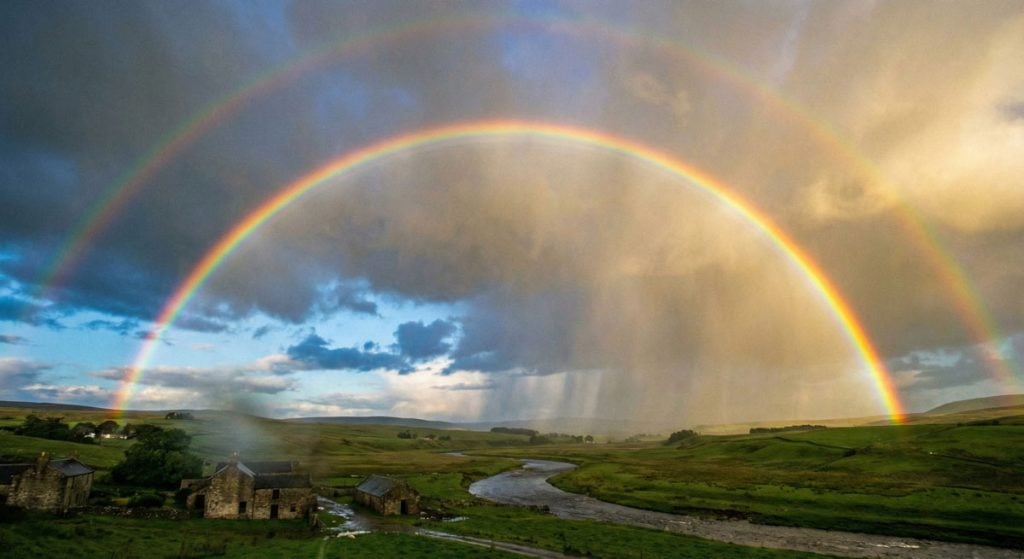
The Second Bow: A Trick of the Light
To understand the double rainbow, we have to look at the first one.
A standard rainbow forms when sunlight enters a raindrop, bends (refracts), bounces off the back of the drop (reflects), and bends again as it leaves. It acts like a tiny prism, splitting white light into the spectrum we know and love: Red, Orange, Yellow, Green, Blue, Indigo, Violet.
But sometimes, sunlight hits the raindrop at just the right angle to bounce twice inside the drop before it leaves.
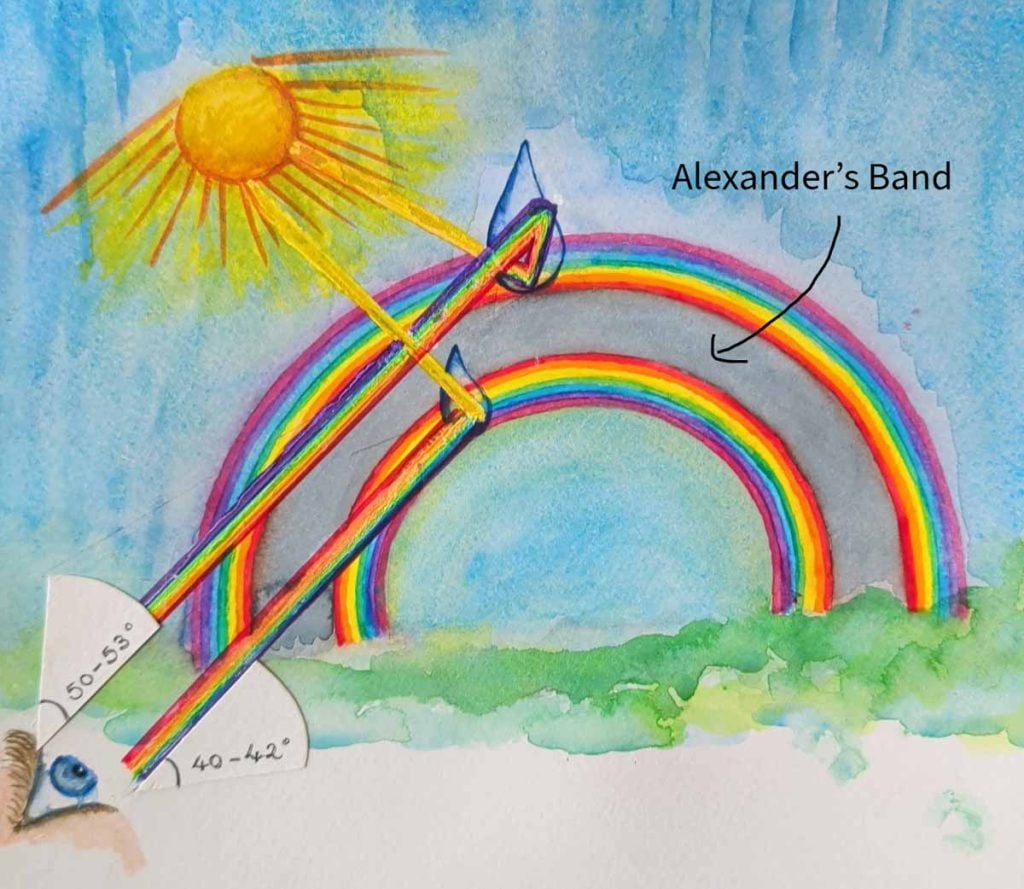
This double bounce is what creates the secondary rainbow. Because the light has bounced an extra time, two things happen:
- It is Fainter: More light is lost with every bounce, which is why the second bow is always ghost-like compared to the first.
- It is Reversed: The extra reflection flips the image. If you look at the primary rainbow, Red is on the outside. But look at the secondary bow, and you will see Red is on the inside.
What is Alexander’s Band?
Now, look at the space between the two rainbows. You will notice it is significantly darker than the sky outside the bows or inside the main arch.
This dark strip is called Alexander’s Band.

It is named after Alexander of Aphrodisias, a Greek philosopher who first described it way back in 200 AD. It took him looking up at the sky 1,800 years ago to ask the question: “Why is the middle bit dark?”
The “No-Fly Zone” for Light
The explanation is a brilliant bit of geometry.
Raindrops are very specific about where they send light.
- The Primary Rainbow concentrates light at an angle of roughly 40–42 degrees relative to your eye.
- The Secondary Rainbow concentrates light at roughly 50–53 degrees.
Because of the laws of optics (specifically the refractive index of water), raindrops cannot scatter light into the area between these two angles (roughly 42° to 50°). They literally direct the light away from that zone.
See the ilustration above.
So, when you look at Alexander’s Band, you are looking at a region of the sky where the raindrops are refusing to send sunlight to your eyes.
The brightness you see inside the main rainbow is the scattered light; the darkness in the band is the absence of that scatter.

A Photographer’s Tip
Capturing this on camera can be tricky because cameras often try to “brighten” dark scenes.
If you want to show off Alexander’s Band in your photos:
- Underexpose slightly: If you expose for the dark ground, the sky will wash out. Expose for the bright sky to make the colours pop and the dark band appear deeper.
- Look for a dark background: The effect is most visible when the rainbow is framed against dark storm clouds rather than blue sky.
A Moment of Wonder
Next time you are caught in a shower and the sun peeks out, don’t just snap a photo and walk on. Take a moment to really look.
Check the colour order. Look for the “ghost” bow. And look for that band of darkness in the middle. It’s a reminder that even something as ethereal as a rainbow is governed by the strict, beautiful laws of physics.
Alexander of Aphrodisias noticed it nearly two millennia ago; it’s quite a feeling to stand there and share his view.
The vibrant colors we see in a rainbow are a reminder that ‘white’ sunlight is actually a mixture of every colour in the spectrum.
These same colors are responsible for the sky’s appearance; however, instead of being bent by rain, the blue wavelengths are scattered in every direction by the gases in our atmosphere. See our in depth guide on that at Why is the Sky Blue? Unveiling the Physics of Nature’s Palette

















 English (US) ·