
 5 hours ago
4
5 hours ago
4
It is difficult to overstate just how interesting Cusco is. It rose as the capital of the Inca Empire, the largest indigenous empire in the Americas, and is now Peru’s undisputed tourism capital. Inca walls are built into the highest altitude Irish pub in the world, poncho-clad locals lead alpacas past Starbucks and all around the Andes loom. There is nothing like it in the world.
I visited twice, first staying for two weeks in 2023, and returning in 2026 to spend an entire month in the Inca capital. Would I go back again? Absolutely. Far from just a gateway to Machu Picchu, Cusco rewards those who dig deeper. The list of things to do in Cusco and the surrounding area feels bottomless but I have condensed it into the very best.
Whether you’re here on a shorter highlights trip, or staying longer-term, let me share how to experience the very best of Cusco.
 Cusco’s urban life squeezed into the rugged Andean landscapeCusco’s urban life squeezed into the rugged Andean landscape
How to get to Cusco
The fastest and easiest way to reach Cusco is by flying. Cusco is directly linked by air to many major Latin American destinations like Bogotá and La Paz, but most will arrive from Lima.
For those on short trips, happy to pay extra to maximise time in the Inca heartland, flying is the best option. If booked in advance, flying can cost as little as $55. (Just keep in mind you’ll be landing at 3,399m elevation, so you may need time to acclimitize.)
You can also book a bus ride online with a local operator. You’ll find all departure towns, trip duration, and ticket price detailed on Bookaway.
- From Lima – 23 hours
- From Arequipa – 11 hours
- From Huacachina (Ica) – 18 hours
- From Puno – 8 hours
Within Cusco, Uber is available for easy and reliable movement around the city. To visit the surrounding towns, collectivos (shared minibuses) go frequently from Calle Pavitos.
Where to stay in Cusco
Far from just a gateway to Machu Picchu, Cusco is the foremost destination in the country. Suitably, it has a range of accommodation options from five-star hotels to simple guest houses and a selection of neighbourhoods to base yourself in.
Cusco is a sizable city of 500,000 inhabitants but its attractions are concentrated on its ancient centre, making it walkable.
One option is simply to stay in the very centre. Many hotels and hostels are within five minutes of the Plaza de Armas. This has the advantage of proximity to restaurants, cafes and bars, as well as being able to pop out of your door and encounter Inca monuments.
Though it can get quite crowded and parts suffer from the scourge of traffic and the Latin tendency to lean on carhorns. On my second stint in Cusco, I stayed just off the Plaza de San Francisco and revelled in its closeness to the brilliant San Pedro market.
The best alternative is the San Blas district. This sits above the historic centre with quite a steep walk up. It has a more laid back artsy vibe, think coca leaf readings, galleries and cafes with trance music playing.
It has brilliant views over the city and the surrounding Andes, including 6000m tall Mount Salkantay. Ideal for a sunset drink. It is also very close to Sacsayhuaman and the countryside behind it for bucolic strolls.
A word of warning is that Cusco is at an altitude of 3400m, so those arriving from the sea will need a few days to acclimatise before taking on difficult hikes. Luckily Cusco has no shortage of things to do before activities like trekking to Machu Picchu.
 Cusco, seen from Casa Encuentro San Blas
A lively backpacker hostel in the historic center with a buzzing social bar and a communal vibe
A homey San Blas guesthouse with sweeping wrap-around views over Cusco, steps from the neighborhood’s artisan lanes and cafés
A charming colonial guesthouse in San Blas with a leafy courtyard, comfy rooms, and a local, central feel
A historic colonial hotel with terraced gardens and rustic balconies overlooking Cusco
A grand colonial hotel set in an 18th-century mansion, centered around courtyards with stone fountains and wooden balconies
Advice on the Boltero Turistico
Before I dive into the activities I should mention the special combination ticket called the Boltero Turistico. Costing 130 soles, it grants access to 16 sites and museums in Cusco and the Sacred Valley for 10 days. It becomes value for money once you’ve visited at least 2 sites, as each costs 70 soles (or ~21USD) per entry. Many of the places mentioned in the article are included in the ticket.
You can buy this at the COSITUC office on 103 Avenida del Sol in central Cusco or at the entrance to any of the ruins.
Top things to do in & near Cusco city
Sacsayhuaman
I think that if you only visit one ruin in Cusco it should be Sacsayhuaman. Machu Picchu has perhaps overshadowed this building, which was the most famous Inca ruin before Machu Picchu’s discovery in 1911. In many ways, Sacsayhuaman was a more impressive feat of engineering than that city in the clouds.
Huge blocks of stones, some up to 120 tons, are perfectly slotted together without mortar, to create an imposing three tiers of cyclopean walls above Cusco. All without wheels or metal tools. In its heyday, it included a huge building complex, a well drawing water up with complex hydraulics and a 50 foot high tower. The first Spaniards to encounter it described it with hyperbole.
 Rehearsals for Inti Raymi (Festival of the Sun) at the megalithic fortress of Saksaywaman
It is debated exactly what it was used for – leading theories suggest that it was a fortress, a temple or some kind of ritual showground. Its sensitivity for the surrounding environment is also incredible.
It mirrors the serrated ridges of mountains behind it, and often incorporates living stone into the structure. It is a monument to the genius of the Inca mind.
It was also the scene of a gruesome battle between the Incas and the Spanish for control of Cusco during the conquest. The brutal siege of the city by Manco Inca was defeated when the Conquistadors stormed Sacsayhuaman. Juan Pizarro, one of the Spanish leaders, was killed beneath these walls.
While you can get a sense of the ruin’s scale for free by looking at it from the footpath, there is nothing like actually walking beneath the stones.

I often think of striding beneath the bottom tier, which has the biggest stones, first almost in disbelief of how stones this large were brought here, but also my wonder at the creativity and planning needed to make a massive wall of different shaped stones that seamlessly blend into each other.
The complex of gates and Inca staircases made me long to see it in its pomp. The view from the top with Cusco spread out beneath the Andes is also incredible. According to legend, the city is in the shape of a puma but you can make up your own mind from here.
Sacsayhuaman also is more than just the main building – there are the remains of terraces, mysterious water shrines and the stone slides (a smooth slope of polished stone of unknown purpose but is today a playground for local children and backpackers).
Sacsayhuaman is a twenty minute walk from the city centre and ten minutes from San Blas. It is a steep path up, so you may feel the 3400m of altitude. Entry is included with the Boltero Turistico, or you can pay 70 soles ($20).
The perfect day 1 intro to Cusco is exploring it with someone who grew up here! We recommend this free walking tour led by a local which will help you get your bearings and gain a deeper appreciation of the historic centre and beyond.
It’s pay-what-you-want, so your guide is truly motivated to let help you see the city in a different light, with donations paid only at the end.
Qenqo, Templo de la Luna and Cristo Blanco mirador
This is a brilliant walk that you can incorporate into your visit to Sacsayhuaman. Just beyond Sacsayhuaman is a wood of pine trees and Quenqo.
It is a mysterious place. Most of it is underground, carved directly into the solid rock, with winding passages, channels and thrones chiselled out. It was probably a site of ritual sacrifices linked to Ukupacha, the Andean underworld.
I also found that it was a great spot for a picnic, as there is a large lawn on the site with a brilliant view over Cusco. Entry is included in the Boltero Turistico.
 (WallisYu/iStock)
I walked further on to Templo de la Luna, a further twenty minutes from Quenqo as part of my first acclimatisation walk in Cusco. You feel very far from a city out here – it is all open grassland with hills rolling up to mountains. This blend between nature and sites typical of a great city is replicated in few other places.
The temple is centred on a massive outcrop of rock, featuring shapes carved into the rock like trapeziums, steps and a large effigy of the moon. It is believed to have once been a place dedicated to female fertility.
When I visited, I found coca leaves left in recesses, a gift by Peruvians who still believe in the forces once worshipped here. The temple is free to enter.
After I visited, I just carried on walking until I found a large outcrop that I climbed for a sublime view straight toward Mount Salkantay.
Just to the side of Sacsayhuaman is Cusco’s answer to Rio’s Christ the Redeemer in Christo Blanco – a giant white figure of Christ overlooking the city. It is worth visiting for the view.
 Cristo Blanco: Cusco’s answer to Rio’s Christ the Redeemer, perched around 2500 m above sea-level
Mercado San Pedro
No other market fitted my image of Peru more than this one. As Cusco is the heart of the indigenous world, this market is awash with local dress of every sort like iconic multicoloured skirts, jumpers, traditional hats and of course ponchos.
While there are some polyester knock-offs, you can also buy quality alpaca products from local people.
I bought myself a poncho which now gets me through the English winter. They also sell the sought after fake Patagonia fleeces, which for legal reasons I will not endorse buying 😉
Behind the clothes section, there are stands for every type of local food and juice. I had a terrible week-long fever, and a daily orange and passionfruit juice helped me beat the bug, shoutout to Tania, my favourite juicer.
The food stands are the cheapest meal in town and I would often buy empanadas for 5 soles ($1) before a hike.
Walk the Inca Streets
Cusco’s streets of intact Inca stonework are unique in the world. Their style of seamlessly slotting cut stones together of different shapes and sizes is earthquake resistant, as the stones can vibrate slightly without collapsing, allowing them to survive when many modern buildings fall.
The style is also utterly beautiful, the combination of stone sizes with how perfectly they were cut feels like the Incas were showing off how advanced their stoneworking was. Today, the Inca walls exist beneath colonial buildings, an interesting visual guide to the city’s history.
My favourite example is Calle Hatunrumiyoc. This combines an Inca wall with a colonial archbishop’s palace. These stones are massive and show the Inca genius for stonemasonry. This street contains the famous twelve-sided stone, which has become a major tourist attraction.
You will find it straight away by the crowd and locals dressed as Incas trying to charge for a photo. Visit early in the morning or at night for a chance to walk through an empty street and imagine that you have time travelled.
Other intact Inca streets are: Calle Loreto, Calle Inca Roca, Asnuq Ch’Utun, Choquechaka and Calle Cori.
 Cusco is reclaiming its heritage by restoring Quechua names to its historic center. Q’aphchik’ijllu, meaning ‘Narrow Street,’ replaces its Spanish name and reflects the original Inca urban planning
Best of Cusco’s museums
Appropriately for one of the richest historical sites on the continent, Cusco’s museum scene is popping. You can visit a museum for essentially every day of your trip, but I will give the pick of the bunch.
If you only visit one museum, make it Museo Arte Precolombio. Even without the museum inside, the building itself would be worth visiting.
It began as an Inca palace, before becoming the residence of a Spanish viceroy. Now it exhibits the 3000 year old history of artistic expression in the Andes.
Beginning with the first flickers of civilisation in Peru, to the work that the Incas produced, you get a sense of what each culture learnt from the other.
The way that the items are displayed as art beautiful on its own terms and not as artefacts from which to learn is an approach not often replicated in South America. The golden items, rare to have escaped the Spanish furnace, were especially eye-catching with their luminosity and throbbing energy. Entry costs 40 soles ($12).
Another good museum, and one included in the Boltero Turistico, is Museo Inka. I liked this museum for its chaos. It is not a curated, modern museum, it feels more like an eccentric collector’s treasures.
 Housed in the 17th-century Admiral’s House, Museo Inka is built directly atop an ancient Inca palace. Here you’ll see a striking balance between colonial architecture and pre-Columbian history
Everything from textiles to Inca weaponry are laid out seemingly at random, allowing the visitor to form their own interpretations of what they are seeing.
The mummy exhibition caught me by surprise. The Incas placed a great deal of value in preserving their dead – mummified emperors would get their own palaces and teams of servants after death, and surviving examples are displayed here.
Some were skeletal and sown into sacks, a pretty scary sight. Museo Historico Regional is also included in the Boltero Turistico, and is worth a look for its exploration of the natural history and earliest human presence in the Valley of Cusco.
Ahead of a visit to Machu Picchu, Museo Machu Picchu is a good crash course in that world wonder to ensure that you get the most out of your experience. It was built to house the returned artefacts found at Machu Picchu that were (naughtily) taken to the USA by its discoverer Hiram Bingham.
 Museo Machu Picchu
It is a typically beautiful courtyard with rooms displaying artefacts combined with detailed digital explainers on life in the Inca citadel.
These vary from weaving to chicha beer production. Items related to the expedition that discovered it, such as original photos of explorers posing in the forested ruins and orders for all of its equipment were fascinating. Entry was 15 soles ($4.50).
Cusco also has a rich religious heritage. After the fall of the Incas, it became a city of churches and convents, even producing its own distinctive style of art, The Cusco School.
This is fascinating for combining Andean religious belief with Christianity, giving images like the Virgin Mary wearing a mountain-shaped dress to preserve indigenous belief in holy mountains with the new religion.
My two favourite museums for this art, and insight into the harsh life of devotees were Santa Catalina Monastery and San Francisco Convent, entry is 8 soles ($2.50) and 15 soles ($4.50) respectively.
The City at the Navel of the World | Cusco’s name comes from the Quechua word qusqu — meaning “navel” — because the Incas saw it as the centre of their entire universe.
Coricancha
This is yet another must see sight in Cusco. The Coricancha was the holiest building in the entire Inca empire. Their calendar was also intimately linked to this building by imaginary lines called ceques drawn to different shrines for each day of the year.
Its name means “golden enclosure” in English, and it was a temple primarily to Inti, the sun god. Being named for gold was wholly appropriate, as it was full of the stuff.
The entire outside was covered with panels of gold, and it featured a to-scale garden featuring solid-gold plants and animals. Needless to say that this is long gone, but the sumptuously designed building remains. The garden made of actual plants was also not half bad too.
 What looks like a Cathedral built on top of a fortress was once the most important temple in the Inca Empire, dedicated primarily to Inti, the Sun God
Like many other Inca buildings in Cusco, it has been incorporated into a colonial one, a Dominican monastery in this case.
Therefore, you get the interesting jumble of the very best stonework in the Inca Empire awkwardly fused with a building that could be in Granada. Perfectly precise blocks of stone forming trapezium-shaped passageways seem more futuristic than something from the past.
There is an option to pay 10 soles ($2) extra to climb the tower of the monastery, which has brilliant panoramic views over Cusco.
I also paid for a guide, which I regretted, as she kept telling me conspiracy theories and false information and then pretending not to understand me when I challenged her on them! Everything is well signposted in English and Spanish.
The Devil’s Balcony
This is a brilliant acclimatisation hike or a way to escape the city for a day. The Devil’s Balcony is a 50m tall rock with a scattering of Inca ruins on its summit. I honestly did not find the ruins particularly life-changing, but the journey there is why I recommend it.
You walk through seemingly untouched Andean countryside – llamas and potatoes farmed as they had been for centuries and you can see Inca aqueducts still irrigating the fields.
I got talking to a friendly farmer who told me that there were more ruins about a kilometre along the path from the Devil’s Balcony, and stumbled across a sumptuous Inca wall built into a hillside above a stream. I felt like a real explorer unexpectedly encountering it and soaking it all up alone.
The walk to the Devil’s Balcony is about two hours from the city centre, and it takes you past Sacsayhuaman. There are no entry fees.
Explore the San Blas Neighbourhood
This is the more bohemian side of Cusco, and even feels like its own little town with a plaza and different vibe. Far from busy streets housing brands like Starbucks or Patagonia, San Blas consists of quiet, winding streets that do not feel like they are in the 21st century. They buzz with independent cafes and artisanal workshops.
San Blas also contains the striking Sapantiana Aqueduct, a three tiered structure still controlling the flow of the P’ujru stream.
Just across from the aqueduct is Calle 7 Borreguitos, one of Cusco’s most photogenic streets. Its steep gradient is adorned with countless hanging flower pots.
 (zamogilnykh/DepositPhotos)
San Blas also has some of the best views in town. Its viewpoint looks straight down onto the Plaza de Armas and the surrounding Andes. The best time to visit is at night, when the city lights illuminate the Plaza and the orange glow creeps up the mountainside. Once I caught a firework display from here.
This magnificent view can also be experienced, cocktail in hand, from San Blas’ bars. I would recommend ViewHouse and Limbus Bar especially for their atmosphere and service.
Cusco Cathedral
If you only visit one religious building in Cusco, make it the cathedral. This dominates the Plaza de Armas and the city’s skyline.
The inside is just as powerful – designed as a monument to Catholic Spanish power, it makes the visitor almost tremble beneath the high ceilings, gory crucifixes and huge works of art. Any illiterate visitor would soon learn what the Spanish and their Catholicism was all about.
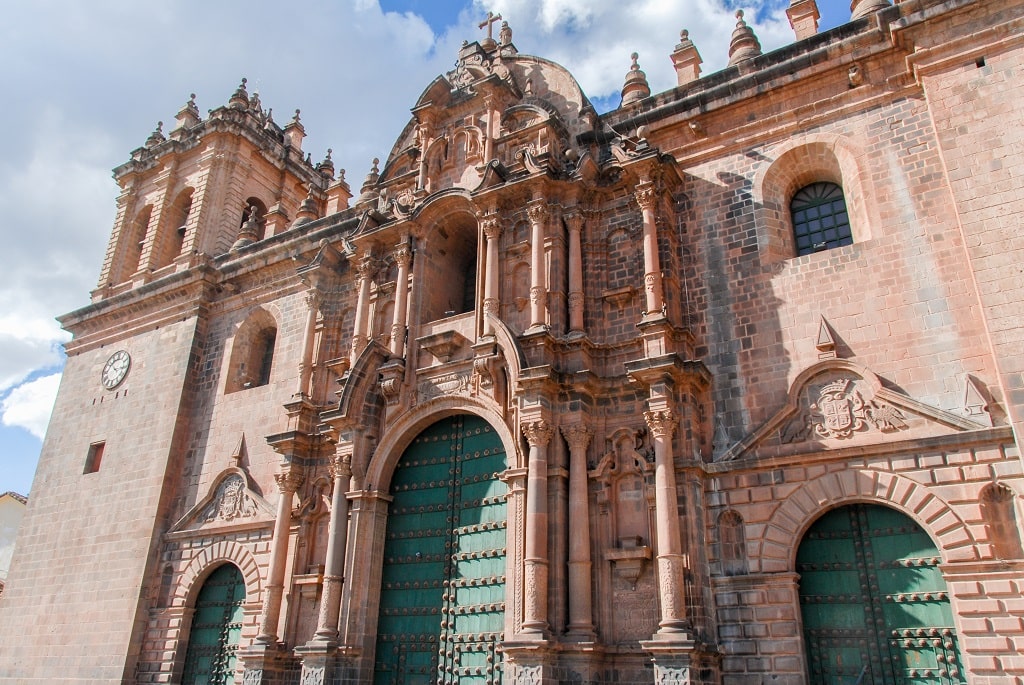
The most famous image in the cathedral is one of the Last Supper, though with an Andean twist. Jesus and his disciples are eating guinea pigs.
There is also a black crucifix known as the Lord of Earthquakes, which the citizens of Cusco paraded around their city for centuries to protect themselves against tremors. Watching the devout fervently praying to this idol makes you conscious of the living history in Cusco. Entry costs 40 soles ($12).
Eat your way through Cusco
Cusco has something for every palate, and in my time here I had some outstanding meals. For brunch, I would recommend Jack’s.
This is a cosy cafe offering delicious international food and hugely popular with the backpacking crowd. A stack of maple-syrup drenched pancakes was a perfect hangover cure after a night in Chango, Cusco’s biggest nightclub.
Cafes were plentiful in Cusco too. For the overall best coffee, Three Monkeys was hard to beat. This felt more like a wine tasting than a casual cup, with menus informing the altitude-grown and tasting notes for each bean.
It was definitely the best cup of coffee I had in South America, and is worthy of its recognition as one of the top 100 coffee shops in the world.
For a more casual, and cheaper, cup of coffee, I kept going back to Café Dwasi, who did excellent coffee and sandwiches for bargain prices.
I tried Chifa, the Peruvian take on Chinese food for the first time in Cusco, which soon became a staple of my diet. For 15-20 soles ($4.50-$6), you get two courses of soup or wanton crackers, with a humongous portion of stir fried rice or noodles. Chifa Hao Yun was particularly good.
Other international restaurants I recommend are Fuego; a burger joint with a brilliant view over the Plaza de Armas, Taste of India for my fill of my favourite cuisine and Green Point for high end vegan food based on traditional Peruvian recipes.
Cusco is the perfect place to try classic Peruvian cuisine. There are plentiful options for a Menu del Dia, a two course meal of quinoa soup with a main course for 11-15 soles.
Dishes include Lomo Saltado, a beef strifry, Chicharron, deep fried crispy pork, or Bisstek, a fillet of steak. Many Peruvian restaurants offer cuy, roasted guinea pigs. Be warned, they are served with the head attached!
Parades and festivals in Cusco
What I loved so much about Cusco is that so much of it was living, breathing culture, not just museum exhibits. The people of Cusco will use just about anything as an excuse for a parade – protesting water shortages? Throw on indigenous clothes and take to the streets with music and dance, anniversary of a local school’s founding? Do the same.
Most days, there will be a procession along Avenida del Sol and the Plaza de Armas, and basically every weekend. The rush of colours and the beauty of whirling skirts and ponchos never failed to amaze me.
Parades peak during festival dates. The most notable are Inti Raymi (21st June), Holy Week (Easter) and Andean New Year (1st August).
I was lucky enough to be in town for Inti Raymi in 2023, and it was spectacular. This is the traditional celebration of Winter Solstice, the Inca sun god and traditional creation beliefs.
There is a whole week of parades and street parties leading up to the main event. This begins at 7 am in the Plaza de Armas with parades of locals dressed up as Incas, brandishing spears and playing traditional pipes.
The Inca stands atop a litter waving at the crowds. The procession moves up to Sacsayhuaman, where mass dance displays are held on the stone terraces and the Inca is ritually crowned. Huge crowds watch, passing around buckets of chicha, a traditional beer made of corn.
I would recommend planning your Cusco trip around this festival, but do book accommodation early as people travel from across South America for this festival.
Best day excursions from Cusco
The city alone is among the most interesting on the continent, but Cusco also offers day trips to enigmatic ruins and sublime mountain landscapes.
The hugely variable altitudes in the Andes mean that a short drive can mean a 1000m or more change in altitude, which completely alters the land, turning temperate Cusco into stark mountainside or sub-tropical scenes. Use this geography to experience many different biomes.
1. The Sacred Valley
The Sacred Valley was the Inca heartland; well preserved towns and temples dot this valley beginning in Cusco and finishing at the approach to Machu Picchu.
 Andean Mountains valleys & Inca ruins (iStock/Jekaterina Sahmanova)
This beguiling region is worth a deeper look, but it can also be seen by a whistle-stop tour through the most notable sights. This will cost around 80 soles ($23). This does not include site entries which are covered by the Boltero Turistico.
A typical itinerary will start early, at around 7am and return by 6pm. The included towns are:
- Chincero – a sprawling archeological site and a center for indigenous weaving
- Moray – a mysterious set of circles hewn into the earth with theories suggesting that they were either a water temple or even a bioresearch lab
- Maras Salt Mines – a mine operated since Inca times that looks like an artist’s palette,
- Ollantaytambo – a continuously inhabited Inca city with jaw dropping temple and terrace ruins, and finally,
- Pisac – a hilltop complex with sweeping terraces.
Each of these towns can be visited individually as a day trip, as none are more than two hours from Cusco. Collectivos will go to each destination from Calle Pavitos.
Tours of the valley usually combine several stops in a single day — it’s vast and there’s a lot to cover. This Viator tour follows a different route order to avoid the usual tour-bus waves.
With only 8 people in the group, you’ll visit Chinchero, Moray, Maras, and Ollantaytambo in a sequence that reaches the same iconic sites with far fewer people around.
2. Rainbow Mountain
This surreal-looking landmark scarcely looks natural, yet the pastel-shaded bands are the result of natural minerals being deposited in what were once shallow seas lifted up by tectonic forces over millions of years to create a mountain seemingly decorated with brushstrokes.
It is also an exhibit of the effect of climate change on the Peruvian Andes. It lay beneath an icecap for millenia, until uncovered in 2018 as the glacier melted. Overnight it became a tourist sensation.
It is at perhaps the most inhospitable location for such a popular attraction. At 5100m above sea level, it is not much lower than Everest Base Camp.
If you do this on your first day in Cusco, you will struggle, so give yourself a few days to acclimatise. Do not be one of those people crying out for oxygen and being basically carried to the mountain! The weather conditions are extreme, so wrap up warm. Tours typically cost 80-90 ($23-$27) soles, and do not include the 20 soles ($6) entry fee.
The pick up is at 5AM, and the drive is 3 hours each way. Most tours give you two hours to do the 2km hike to the famous summit. A word of warning is that you will not be alone.
Behind the Instagram perfect pictures is a carnival of food vendors, locals selling photo ops with alpacas and of course an impatient queue of people waiting for that dream shot. You just have to embrace it. Pose with the alpacas and strike those poses! Your friends and family will love it.
Wake up before sunrise and venture into the Andes to explore the Rainbow Mountain and the Red Valley. This full‑day from Cusco mixes raw Andean terrain with a warm hospitality: early breakfast, a buffet lunch of Andean classics, and a guide who makes sense of the altitude, wildlife, and culture along the way.
For a more natural experience with the surreal colours, the Red Valley is your best bet. This extends the trippy palette of Rainbow Mountain to all angles with less tourists. I was told by many that this was the highlight of the mountain.
I, however, fell foul of a scam when buying my ticket and found out on the mountain that it was not included. Maybe the lesson was to just pay 10 soles ($3) more for a more reputable operator than a back alley guy!
Palccoyo, known as the other Rainbow Mountain, is a good option for a similar experience with less crowds. It involves an easier hike at a milder altitude too.
3. Ausangate Seven Lakes Circuit
This is my personal most underrated attraction in Cusco. All of the fame goes to Rainbow Mountain and Machu Picchu, which are great, but this circuit around crystalline lakes and sacred snow-covered mountains belongs in the same sentence.
Ausangate is a 6384m tall peak, which was holy to the Incas and worshipped as an Apu, a mountain god. Its luminous beauty of stark rock and piercing glaciers equals that found in Huayhuash or Patagonia.
As many people will only visit Cusco or the South of Peru, Ausangate is a good way of experiencing the high Andes in a short trip. There is also a 5-day hike through the entire Ausangate region. The day trip follows the path of the final day’s hiking.
 (MiguelZafra/iStock)
As the name suggests, you hike between seven lakes. Pick up is at 4:30-5AM, followed by a 3 hour drive to the trailhead. The circuit takes about six hours to walk, and is not particularly strenuous. Make sure that you are acclimatised to the altitude, as the highest point of the hike is 4700m.
My quick-thinking companion had the genius idea of walking the trail in reverse from everyone else. This gave us solitude in the mountains and shining lakes. Though the solitude was not complete as friendly trail dogs guided us and we saw herds of hundreds of alpacas. The highlight was witnessing a massive avalanche from the flanks of Ausangate – I had no idea that snow rolling down would sound like an artillery barrage.
The circuit begins and ends at a natural hotspring, allowing for a well deserved soak. I paid 90 soles ($26).
4. Waqrapukara
Like Ausangate, I am not sure why this is not a bigger attraction than it is. The name means horned fortress in Quechua, a wholly apt name for this landform with stone spires soaring above an outcrop against the Apurimac Canyon. It was probably not a fortress though, as there is little out here in the wilderness to defend, but was likely a religious site.
 This remote fortress was both a strategic military lookout and a sacred ceremonial center
It was settled by a pre-Inca culture, and then later venerated by the Incas for its shape, which resembles a llama. The result is a ruined complex in a setting every bit as impressive as Machu Picchu’s – sheer drops of almost 1000m, naked layers of rocks toppled atop each other and seemingly endless ridges of jagged mountains and canyons tapering to the horizon.
The only word of warning is that visiting Waqrapukara is not a relaxing experience. Tours leave at 3am and involve five hours each way over poorly maintained roads.
The hike itself is also difficult, with steep ascents and descents, though only with 400m of elevation gain. I got particularly unlucky when my bus driver had a nervous breakdown, leaving me stranded at the exit for six hours without food!
5. Lake Humantay
There is something so special about that shade of blue you only get at the tropics or in mountain lakes found at extreme altitudes, and you can find it here at Cusco. That it is found at the base of the 5473m-tall Nevado Humantay just makes it even more extraordinary.
The lake is the starting point of the Salkantay Trek to Machu Picchu, but for those not hiking and not wanting to miss out on this natural gem, there are day trips up to the lake.

Like most excursions in Cusco, this begins early at 5 am, requiring two-and-a-half hours of driving each way. It takes two hours to hike up to the lake, and the path is very steep, so expect to earn your view with some determined walking.
Tours cost around 80 soles ($23) and do not include the 20 soles ($6) entry fee. This top-rated Viator tour from Cusco handles the transport and guide so you can just focus on the hike.
Build out your route with this 2-week southern Peru guide. If you have time, be sure to add a stop in Arequipa, a gorgeous city and the perfect gateway for exploring the nearby Colca Canyon.
When you’re ready to venture further, Tom’s guide to Huaraz covers everything you need for Peru’s northern trekking heartland.







 English (US) ·